Beyond the Thesis With Papa PhD
Real PhDs. Real Journeys. Beyond Academia.
Listen on:








Episodes
Thursday Jan 18, 2024
Thursday Jan 18, 2024
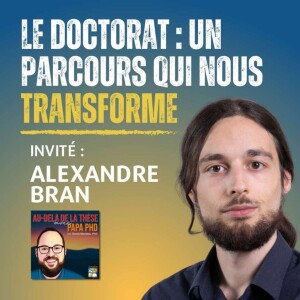
Bienvenue à ce nouvel épisode d'Au-delà de la thèse avec Papa PhD !Cette semaine, je parle avec Alexandre Bran, docteur en psychologie sociale intéressé à l'étude des vécus pendant et après le doctorat.
Docteur en psychologie sociale, Alexandre Bran conduit des recherche pour étudier les vécus pendant et après le doctorat. Il s’intéresse à des thématiques telles que le stress pendant le doctorat, les stéréotypes associés aux docteurs, ou encore les perceptions qu’ont les doctorantes et doctorants d’eux-mêmes.
Avec Alexandre, on a parlé, entre autres :
de l'identité pendant le doctorat – le passage du statut d'étudiant à celui de chercheurddes "vécus" du doctorat (enseignement, publication, stress...) et des façons dont ça nous transformedes compétences développées pendant le doctorat, en particulier celles dont on n'a pas forcément conscienceTu aimes Papa PhD ? Laisse-moi un commentaire > ici < - une courte phrase suffit ! Et inclus ton identifiant Twitter – comme ça je pourrai te remercier personnellement !
Merci Alexandre !
Si cet entretien avec Alexandre Bran t'a plu, fais-lui en part en cliquant sur le lien ci-dessous et en lui laissant un message sur LinkedIn :Clique ici pour le remercier sur Linkedin !Clique ici pour partager avec David le principal message que tu retiens de cet épisode !
Les ressources de cet épisode :
Laboratoire Interdisciplinaire sur le Doctorat, Adoc Talent Management | Site webSi tu trouves de la valeur dans le contenu que je t'apporte chaque semaine, clique sur l'un des boutons ci-dessous et renvoie-moi l'ascenceur :)
Don sécuritaire sur PayPal
Deviens supporter sur Patreon !
Ou paye-moi un café :)
Tu aimeras aussi ces épisodes :
Martin Carli – La vulgarisation grand public : PapaPhD.com/242Bruno Lamolet - Écrire la science pour tous : PapaPhD.com/237Rémi Quirion – Projeter les jeunes chercheur.e.s dans des carrières d'avenir : PapaPhD.com/203Nathalie Ouellette – L'astrophysique à la portée de tous : PapaPhD.com/nathalie-ouellette/
Thursday Jan 11, 2024
Thursday Jan 11, 2024
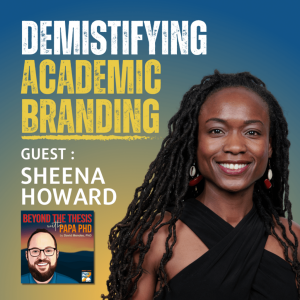
This week on Beyond the Thesis With Papa PhD we will be talking about demystifying academic branding with Dr. Sheena Howard, author of "Black Comics: Politics of Race and Representation", "Black Queer Identity Matrix: Towards An Integrated Queer of Color Framework", "Critical Articulations of Race, Gender and Sexual Orientation", and "Encyclopedia of Black Comics", who is now preparing to publish her new book: "Academic Branding - A step-by-step guide to increased visibility, authority, and income".
Dr. Sheena C. Howard is the first Black woman to win an Eisner award at San Diego Comic-Con for her first book, Black Comics: Politics of Race and Representation (2014). The Eisner is considered the ‘Oscars of Comics.’ Howard has published comic books for both Marvel (Illusion of Fairness, 2023) and DC (Fresh Air in Philly, 2021, and others) comics. She has written a graphic novel and stage play for DMC (from RUN-DMC), published with Bloomsbury (Black Comics: Politics of Race and Representation, 2014), Chicago Review Press (Encyclopedia of Black Comics, 2017), BenBella Press (Why Wakanda Matters, 2021), and more. In addition, her work has received numerous book awards, including an American Library Association’s Outstanding Reference Sourcebook award and more. Her books have been featured in Good Morning America, The New York Times, The Washington Post, and more. She is also the subject of an Emmy-nominated episode of State of the Arts. Finally, Dr. Howard writes and ghostwrites for celebrities, CEOs, and social impact companies that seek to empower, inspire and motivate.
What we covered in the interview:
Academic Branding: Monetizing expertise, increasing visibility, income Financial Stability: Challenges of academia, diversifying income streams Mindset: Unlearning academic norms, prioritizing personal growth Professional Growth: Expanding beyond academia, long-term planning Media Coverage: Pitching to newspapers, leveraging previous exposure Speaking Engagements: Strategically setting fees, advancing professional status Exit Strategy: Preparing for transition, building personal brand
This episode’s resources:
Power Your Research | WebsitePre-order "Academic Branding - A step-by-step guide to increased visibility, authority, and income" | Book
Thank you, Sheena Howard!
If you enjoyed this conversation with Sheena, let her know by clicking the links below and leaving her a message on Linkedin:Send Sheena Howard a thank you message on Linkedin!Click here to share your key take-away from this interview with David!
Leave a review on Podchaser !
Support the show !
You might also like the following episodes:
Adriana Bankston and Jamie L. Vernon – Making an Impact in Research Through Science PolicyAmal Abuzeinab – Flourishing in Your PhD and BeyondMerle van den Akker – Debunking PhD MisconceptionsEmma Brodzinski – Supporting and inspiring graduate studentsAs always, if you find value in Papa PhD and in the content I bring you every week, click on one of the buttons below and send some of that value back to me by becoming a supporter on Patreon or by buying me a coffee :)
Support the show on Patreon !
Or buy me a coffee :)
Thursday Jan 04, 2024
Thursday Jan 04, 2024
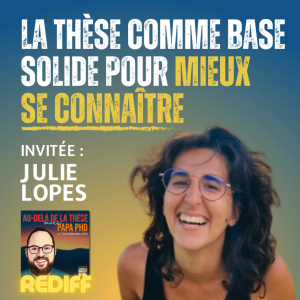
Cette semaine sur Au-delà de la thèse avec Papa PhD, je t'apporte un des épisodes les plus écoutés de la saison 4 – ma conversation avec Julie Lopes, accompagnatrice de doctorant.e.s.La thématique - profiter du doctorat pour mieux se connaître et profiter de mieux se connaître pour avoir un trajet plus aligné et plus productif pendant la thèse.En fin d'épisode, Julie nous fait expérimenter un exercice de recentrage qu'elle utilise avec les personnes qu'elle accompagne. Si tu as besoin de calmer ton corps et ton esprit, ne le manque surtout pas !Julie Lopes est docteure en microbiologie reconvertie dans l'entrepreneuriat auprès des étudiant·e·s, doctorant·e·s et docteur·e·s.Sa mission est de les accompagner vers une expansion d'eux-mêmes afin qu'ils choisissent un avenir dirigé par leur cœur plutôt que par la peur !
Les ressources de cet épisode :
Julie Lopes | LinkedInJulie Lopes | Site webJulie Lopes | Instagram
Merci Julie !
Si cet entretien avec Julie Lopes t'a plu, fais-nous en part en cliquant sur les liens ci-dessous et en nous laissant un message :Clique ici pour remercier Julie Lopes sur LinkedIn !Clique ici pour partager avec David le principal message que tu retiens de cet épisode !Si tu trouves de la valeur dans le contenu que je t'apporte chaque semaine, clique sur l'un des boutons ci-dessous et renvoie-moi l'ascenceur :)
Don sécuritaire sur PayPal
Deviens supporter sur Patreon !
Ou paye-moi un café :)
Tu aimeras aussi ces épisodes :
Charlotte Hendryckx – L'aventure du doctorat à l'étranger : PapaPhD.com/193Erika Dupont – Le parcours doctoral est-il au service de chercheurs ? : PapaPhD.com/175Jean-Patrick Toussaint – Mieux préparer les doctorants à l'emploi : PapaPhD.com/155Myriam Beaudry - L'importance de rencontrer d'autres chercheur.e.s pendant ton doctorat : PapaPhD.com/183
Thursday Dec 28, 2023
Thursday Dec 28, 2023
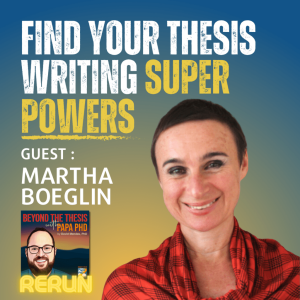
Do you struggle to sit down and write your thesis? Is the process painful to you?Then join me in one of the most listened episodes of last season with a specialist, a "thesis whisperer" of sorts - Martha Boeglin of Scriptoria.During my conversation with Martha, we discuss this inevitable, yet often gruesome task that is thesis writing, and Martha shares her know-how and a number of techniques and strategies to make the exercise a pleasant and successful one.
When she wanted to write her thesis in Philosophy, Martha Boeglin was paralyzed for many months by the fear of the blank page.When she eventually understood that the fear of the blank page is normal, that almost every researcher is concerned by writer’s block… ant that writing problems are tabou at university, she started to investigate the phenomenon of writing.One discovery changed her life: writer’s block belongs to the writing process – and there are lots of creative writing techniques to overcome them.More: some writing techniques hold an almost magical power.Why are they not taught at university ?Her passion for writing techniques was born. With a double consequence: first, once she overcame that initial writer’s block, she was able to write her thesis – and worte it in a wave of euphoria.Second, once she got her Dr. Titel, she created Scriptoria, the writing workshops for PhD students in 2002.Its goal? To make writing a thesis easier: when you know the right techniques, writing is no longer a chore - it can even become a source of joy.
Thank you, Martha Boeglin !
If you enjoyed this conversation with Martha, let her know by clicking the link below and leaving her a message on Twitter:Send Martha Boeglin a thank you message on Twitter!Click here to share your key take-away from this interview with David!
This episode’s resources:
Martha Boeglin | LinkedInMartha Boeglin | TwitterScriptoria | Scriptoria.org | Groupe Facebook | Youtube
You might also like the following episodes:
Albertha Joseph-Alexander – Using SciComm to Make a DifferenceDavid Giltner – Reconciling the Research and Development MindsetsJen Polk – Are You a Sellout if You Leave Academia After Your PhD?Natalia Bielczyk – Figuring Out Where You Fit in the Job Market as a PhDAs always, if you find value in Papa PhD and in the content I bring you every week, click on one of the buttons below and send some of that value back to me by becoming a supporter on Patreon or by buying me a coffee :) Now with the added perk of receiving the brand new Papa PhD and PhD Dojo stickers!
Support the show on Patreon !
Or buy me a coffee :)
Get the Papa PhD Career Readiness Tool kit !
Thursday Dec 21, 2023
Thursday Dec 21, 2023
Bienvenue sur « Horizon PhD » - le balado qui explore des milieux insoupçonnés où tu peux mettre en valeur ton doctorat.Dans cet épisode, je t’emmène dans un univers très particulier... celui des représentations du Québec à l'étranger.Pour t'accompagner dans la découverte de la diplomatie scientifique et de la valeur ajoutée que tu peux y apporter avec tes talents en recherche, je parle avec Luc Bergeron, des Fonds de Recherche du Québec, et avec Jean-Christian Lemay, participant à l'édition 2018 du programme « Scientifiques en résidence » des FRQ et membre fondateur d'une communauté passionnée de jeunes scientifiques comme toi.
Avec Luc et Jean-Christian, on a parlé, entre autres :
Du rôle des scientifiques en résidence au sein du programme des FRQ et des types de missions qui leur sont confiées.De l'importance de l'esprit scientifique et de la polyvalence scientifique pour aborder les enjeux complexes dans les représentations du Québec à l'étranger.De l'écosystème de la recherche à l'international et de la création de partenariats dans le domaine scientifique.De l'importance de comprendre les politiques et les plans stratégiques en matière de recherche scientifique, en tant que scientifique en résidence.De pourquoi tu devrais postuler au programme des scientifiques en résidence, même si tu hésites, en ce moment.Si tu veux en savoir davantage sur les programmes « Scientifiques en résidence » des Fonds de Recherche du Québec, rends-toi sur :
PapaPhD.com/HorizonPhDFRQ
Bonne écoute et bonne exploration !
Tu aimeras aussi ces épisodes :
Rémi Quirion – Projeter les jeunes chercheur.e.s dans des carrières d'avenir : PapaPhD.com/carrieres-davenir-remi-quirion/Martin Primeau – profession de communicateur scientifique : PapaPhD.com/martin-primeau-2Bruno Lamolet - Écrire la science pour tous : PapaPhD.com/ecrire-la-science/Nathalie Ouellette – L'astrophysique à la portée de tous : PapaPhD.com/nathalie-ouellette/
Thursday Dec 14, 2023
Thursday Dec 14, 2023
Bienvenue sur « Horizon PhD » - le balado qui explore des milieux insoupçonnés où tu peux mettre en valeur ton doctorat.Dans ce premier épisode, je rejoins Jules Racine-St-Jacques pour partir à la découverte d'une belle organisation au sein de laquelle tu peux mettre en valeur tes compétences transversales et ton diplôme doctoral - le service de recherche de la bibliothèque de l'Assemblée nationale du Québec.Si tu t'intéresses à la visualisation des données et que tu as envie de travailler sur des projets ayant un impact sociétal et politique, ta chance est peut-être venue de faire le saut et de tester les eaux au sein d'une équipe passionnée de scientifiques comme toi !
Ce que tu apprendras dans cet épisode :
Qu'est-ce que le service de recherche de la bibliothéque de l'assemblée nationaleComment fonctionne l'équipe du service de rechercheLes types de mandats variés sur lesquels tu pourras travailler en tant que scientifique en résidenceLes opppoortunités de carrière au sein de l'Assemblée nationale du QuébecPourquoi tu devrais postuler au programme Scientifiques en résidence des FRQSi tu veux en savoir davantage sur les programmes « Scientifiques en résidence » des Fonds de Recherche du Québec, rends-toi sur :
PapaPhD.com/HorizonPhDFRQ
Bonne écoute et bonne exploration !
Tu aimeras aussi ces épisodes :
Rémi Quirion – Projeter les jeunes chercheur.e.s dans des carrières d'avenir : PapaPhD.com/carrieres-davenir-remi-quirion/Nathalie Ouellette – L'astrophysique à la portée de tous : PapaPhD.com/nathalie-ouellette/Martin Carli – La vulgarisation grand public : PapaPhD.com/242Olivier Bernard – Déboulonner la pseudoscience : PapaPhD.com/olivier-bernard/
Thursday Dec 07, 2023
Thursday Dec 07, 2023
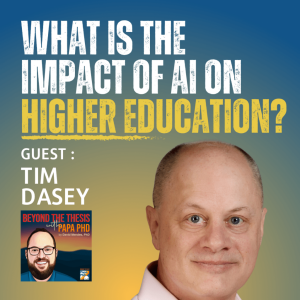
This week on Beyond the Thesis With Papa PhD we will be discussing "What is the Impact of AI on Higher Education?" with Tim Dasey, author of the book "Wisdom Factories: AI, Games, and the Education of a Modern Worker".
Dr. Tim Dasey has a long history in AI and learning science, and recently published the book “Wisdom Factories: AI, Games, and the Education of a Modern Worker.” After thirty years at MIT leading AI development for diverse government needs, Tim leapt into education due to concern that minds won’t be ready for the jobs that remain human. He has a smidge of teaching experience at corporate, higher ed, and K-12 levels. Dr. Dasey has atypical perspectives on the future of schooling built from a blend of AI expertise, experience with many industries, depth in the science of learning and judgment, and more than a decade leading development of game-based learning tools.
What we covered in the interview:
The role of AI in managing tasks and abstracting information: AI and other technologies are revolutionizing the way we work, freeing up our time for more strategic thinking and decision-making. Discover how AI can translate and generate content, reducing labor-intensive tasks.The challenges and opportunities in evaluating AI-generated scientific papers: Join us as we discuss the impact of AI on the peer review process and how institutions like MIT are handling the authenticity and quality of AI-generated research.Nurturing human capabilities alongside AI: Learn about the importance of self-awareness, interdisciplinary approaches, and human collaboration skills in an era of AI. Explore how AI can support individuals in areas affected by conditions like ADHD, as shared by our guest, Tim Dasey.
This episode’s resources:
Tim Dasey | Website"Wisdom Factories: AI, Games, and the Education of a Modern Worker" | Book
Thank you, Tim Dasey!
If you enjoyed this conversation with Tim, let him know by clicking the links below and leaving him a message on Linkedin:Send Tim Dasey a thank you message on Linkedin!Click here to share your key take-away from this interview with David!
Leave a review on Podchaser !
Support the show !
You might also like the following episodes:
Adriana Bankston and Jamie L. Vernon – Making an Impact in Research Through Science PolicyAmal Abuzeinab – Flourishing in Your PhD and BeyondMerle van den Akker – Debunking PhD MisconceptionsEmma Brodzinski – Supporting and inspiring graduate studentsAs always, if you find value in Papa PhD and in the content I bring you every week, click on one of the buttons below and send some of that value back to me by becoming a supporter on Patreon or by buying me a coffee :)
Support the show on Patreon !
Or buy me a coffee :)
Thursday Nov 30, 2023
Thursday Nov 30, 2023
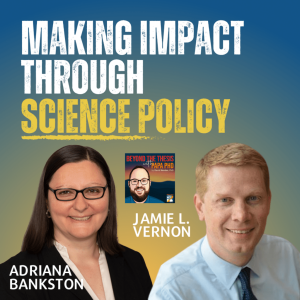
Welcome to Beyond the Thesis With Papa PhD, the podcast that delves into the diverse and impactful roles scientists can play beyond the lab.In today's episode, we explore the intersection of science and policy with our special guests, Adriana Bankston and Jamie Vernon. During our conversation Adriana and Jamie share their personal journeys from the lab to influential roles in science policy.Adriana's passion for policy was sparked during her academic career, leading to her pivotal role at Sigma Xi, while Jamie's trajectory saw him transition from being a molecular biologist to advocating for scientists' involvement in policy.Join us as we unravel the critical roles of scientists in policymaking, the launch of Sigma Xi's Civico, a groundbreaking platform connecting scientists with policymakers, and invaluable advice for early-career researchers looking to leave an impact beyond the thesis.
Adriana Bankston is a Senior Fellow in Civic Science & Public Policy with Sigma Xi, where she leads a project that examines science policy engagement at the state level and determines the skills, knowledge, and resources required by scientists to successfully influence public policy.Prior to this role, Adriana was a Principal Legislative Analyst at the University of California Office of Federal Governmental Relations, where she served as an advocate for the university with Congress, the Administration and federal agencies. Adriana has had a number of roles leading to where she is today and in recognition of her contributions to the field, Adriana was named among the Top 20 in 2022 Advocacy practitioners by the Advocacy Association, and awarded the inaugural 2022 ARIS Emerging Broader Impacts Leader Award. Adriana earned her Ph.D. in Biochemistry, Cell and Developmental Biology from Emory University.Jamie Vernon is executive director and CEO at Sigma Xi and publisher of American Scientist. From 2014 to 2017, he served as Sigma Xi's director of science communications and publications and editor-in-chief of American Scientist. He was also Sigma Xi's co-director of operations from 2014 to 2015. A molecular biologist by training, he transitioned from research in 2011 to serve as an American Association for the Advancement of Science (AAAS) Science and Technology Policy Fellow and an Oak Ridge Institute for Science and Education (ORISE) Fellow in the U.S. Department of Energy. For more than a decade, he has been an advocate for the use of science in decision making at all levels of government, business, and in our personal lives. He holds a B.S. in zoology from North Carolina State University, an M.S. in biotechnology from East Carolina University, and a Ph.D. in cell and molecular biology from The University of Texas at Austin.
What we covered in the interview:
How early-career scientists can effectively integrate policy relevance and societal impact into their researchSpecific opportunities and resources available for scientists to engage in policy work, such as fellowships, internships, and advisory rolesHow scientists can navigate the transition from research to policy, and effective approaches for getting involved in policy work while pursuing a graduate degreeChallenges and benefits of scientists participating in policy discussions and advisory roles at the state and federal levelsHow the Civico platform aims to bridge the gap between science and policy, and what opportunities it offers for scientists at various career stagesManaging time effectively to balance graduate studies with engagement in policy work and advocacy efforts
This episode’s resources:
Civico Platform | WebsiteCivico Launch | VideoCivico Launch | Press Release
Thank you, Adriana Bankston, thank you Jamie Vernon!
If you enjoyed this conversation with Adriana and Jamie, let them know by clicking the links below and leaving them a message on Linkedin:Send Adriana Bankston a thank you mess...
Thursday Nov 23, 2023
Thursday Nov 23, 2023
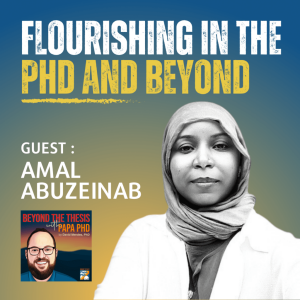
Welcome, friend! This week on Beyond the Thesis With Papa PhD, I'm bringing you a fascinating discussion on adaptation, resilience, and flourishing as a PhD with my guest - Amal Abuzeinab.
Dr Amal Abuzeinab is the Institute Head of Research Students (IHRS), Institute of Architecture, De Montfort University, UK. Amal is currently supervising 3 PhD students, supervised 4 PhD students successfully to completion, and examined 4 PhD students. She served as the Co-Faculty Head of Research Students (FHRS) for the faculty of Arts, Design, and Humanities between 2017-2020.
What we covered in the interview:
The importance of being flexible and adaptable during your research journeyThe need for PhD candidates to anticipate and address potential problemsThe importance of self-selection in pursuing a PhD and becoming an independent researcherThe issue of limited tenure-track positions for PhD graduates The importance of a support system for PhD candidates
This episode’s resources:
Workshop for Women Higher Education Network (WHEN) | Website
Thank you, Amal Abuzeinab!
If you enjoyed this conversation with Amal, let her know by clicking the link below and leaving her a message on Linkedin:Send Amal Abuzeinab a thank you message on Linkedin!Click here to share your key take-away from this interview with David!
Leave a review on Podchaser !
Support the show !
You might also like the following episodes:
Alexandra Howson – A Career in Continuing Medical EducationKate Dahl – Reinventing Yourself after AcademiaMerle van den Akker – Debunking PhD MisconceptionsEmma Brodzinski – Supporting and inspiring graduate studentsAs always, if you find value in Papa PhD and in the content I bring you every week, click on one of the buttons below and send some of that value back to me by becoming a supporter on Patreon or by buying me a coffee :)
Support the show on Patreon !
Or buy me a coffee :)
Thursday Nov 16, 2023
Thursday Nov 16, 2023
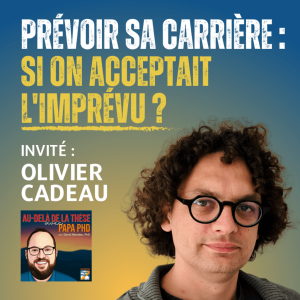
Bienvenue à ce nouvel épisode d'Au-delà de la thèse avec Papa PhD !Cette semaine, je parle du rôle du hasard dans les parcours de carrière avec Olivier Cadeau, doctorant en neuropsychologie de l'enfant et explorateur/expérimentateur de l'apprentissage et du savoir.
Olivier a commencé sa carrière professionnel il y a 20 ans. D’abord comme pâtissier-chocolatier, il est ensuite devenu technicien de la construction puis moniteur auto-école. C’est en se questionnant sur ce qu’était l’apprentissage et pour aider au mieux les élèves qu’il a découvert la psychologie. Tout en continuant à travailler à temps plein, il a commencé son parcours universitaire à distance. Après une licence et un master en psychologie du développement, il est devenu psychologue dans l’Éducation Nationale. Aujourd’hui, il est en doctorat en neuropsychologie de l’enfant en parallèle de son activité de psychologue à l'école.
Avec Olivier, on a parlé, entre autres :
de la curiosité d’aller explorer de nouvelles voiesde comment identifier et améliorer ses points forts, les points d’appui du changementde l'importance de se faire plaisir en visualisant son objectif et de se protéger des peurs des autresTu aimes Papa PhD ? Laisse-moi un commentaire > ici < - une courte phrase suffit ! Et inclus ton identifiant Twitter – comme ça je pourrai te remercier personnellement !
Merci Olivier !
Si cet entretien avec Olivier Cadeau t'a plu, fais-lui en part en cliquant sur le lien ci-dessous et en lui laissant un message sur LinkedIn :Clique ici pour le remercier sur Linkedin !Clique ici pour partager avec David le principal message que tu retiens de cet épisode !Si tu trouves de la valeur dans le contenu que je t'apporte chaque semaine, clique sur l'un des boutons ci-dessous et renvoie-moi l'ascenceur :)
Don sécuritaire sur PayPal
Deviens supporter sur Patreon !
Ou paye-moi un café :)
Tu aimeras aussi ces épisodes :
Martin Carli – La vulgarisation grand public : PapaPhD.com/242Bruno Lamolet - Écrire la science pour tous : PapaPhD.com/237Rémi Quirion – Projeter les jeunes chercheur.e.s dans des carrières d'avenir : PapaPhD.com/203Nathalie Ouellette – L'astrophysique à la portée de tous : PapaPhD.com/nathalie-ouellette/